DATASET 04
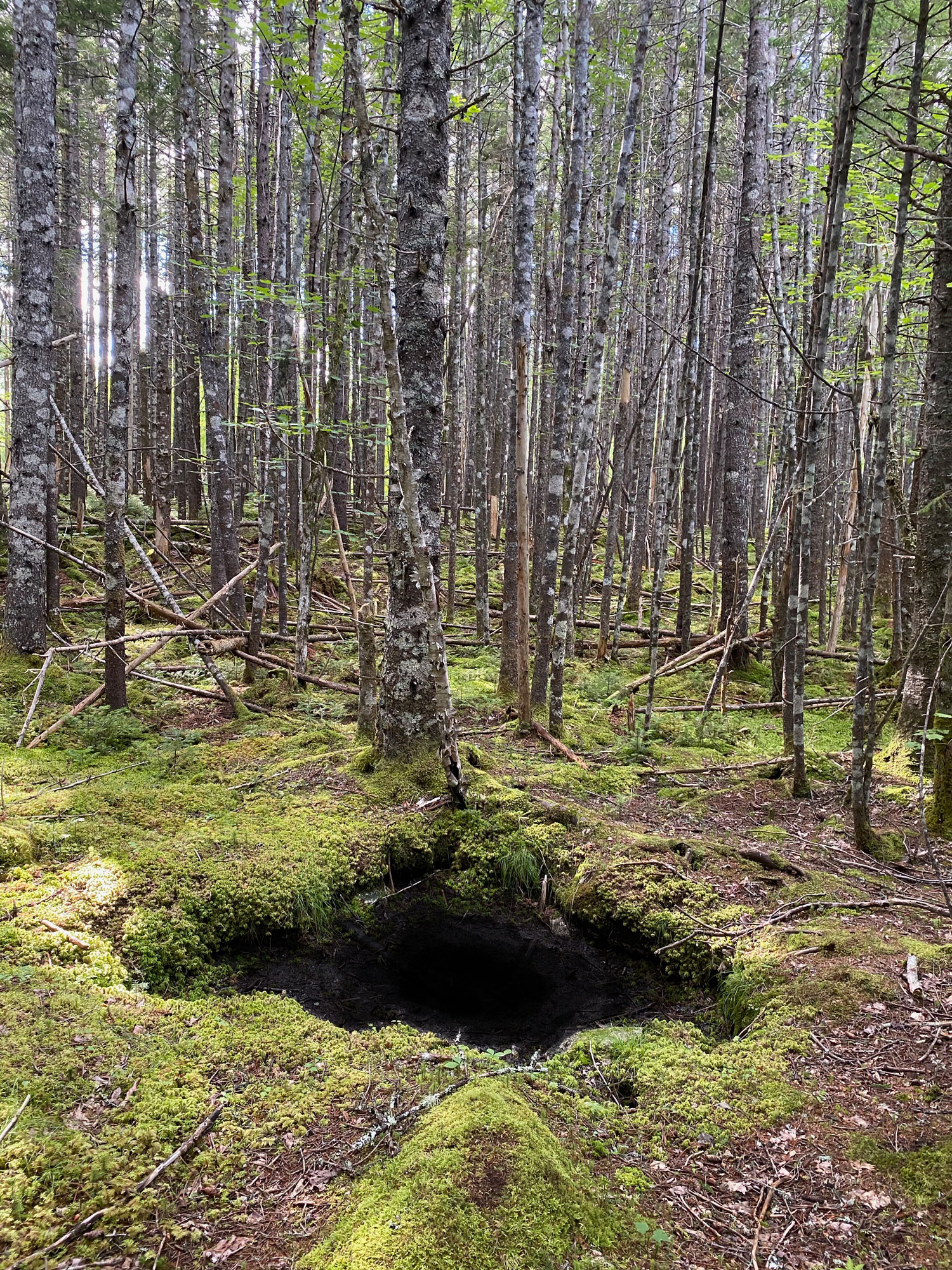
Holes
“Please forgive me for the air of paranoia that permeates this letter. The camp is rife with spies and I’ve become accustomed to sleeping with my sketchbook and a gun under my pillow. If any of this new research were to be reported back to the university, my funding would surely be terminated and these incredible discoveries repressed, erased.”
– Sir Abram Pekoe-Gibson to his wife in a letter dated December 1923, after his archaeological team on Tortoise Island discovered “an array of rectangular holes of great depth, sunken into solid granite by some arcane masonry.”
STATE OF SOULS
People tend to go missing in Backwater.* Most go unrecorded, at least officially. Disappearances occurred so often that the District Council made it mandatory for all citizens and visitors to Pokelogan to submit fingerprints to the census register, known as the State of Souls. Of course, fingerprints are only useful in the advent that a corpse is found in relatively good condition.
Appearing in the “Good Standing” column of the State of Souls was once essential to the health and happiness of a Pokelogan citizen. Flouting Council bylaws, trading in the black market (“on passage”) or committing a crime could result in temporary or permanent exclusion from amenities, services and even housing.
Being made permanently “UNSO”—short for “unsanctioned occupant”—was the harshest punishment the Council meted out, usually in response to repeated antisocial behaviour. Removed from public electric, water and telephone, barred from shops and services, even turned out of homes built on District land, those made UNSO were especially likely to disappear into the unmapped wilderness.
*These days, visiting Pokelogan “officially” is only possible with special permission both from the District Council and MSCC Labs. So our visits have been unofficial and our forays clandestine. We make regular contact with people back home, and in the event that one of us disappears, rest assured the circumstances will be documented.
MICROSPECTROPHOTOMETRY & MILITARY CONTRACTS
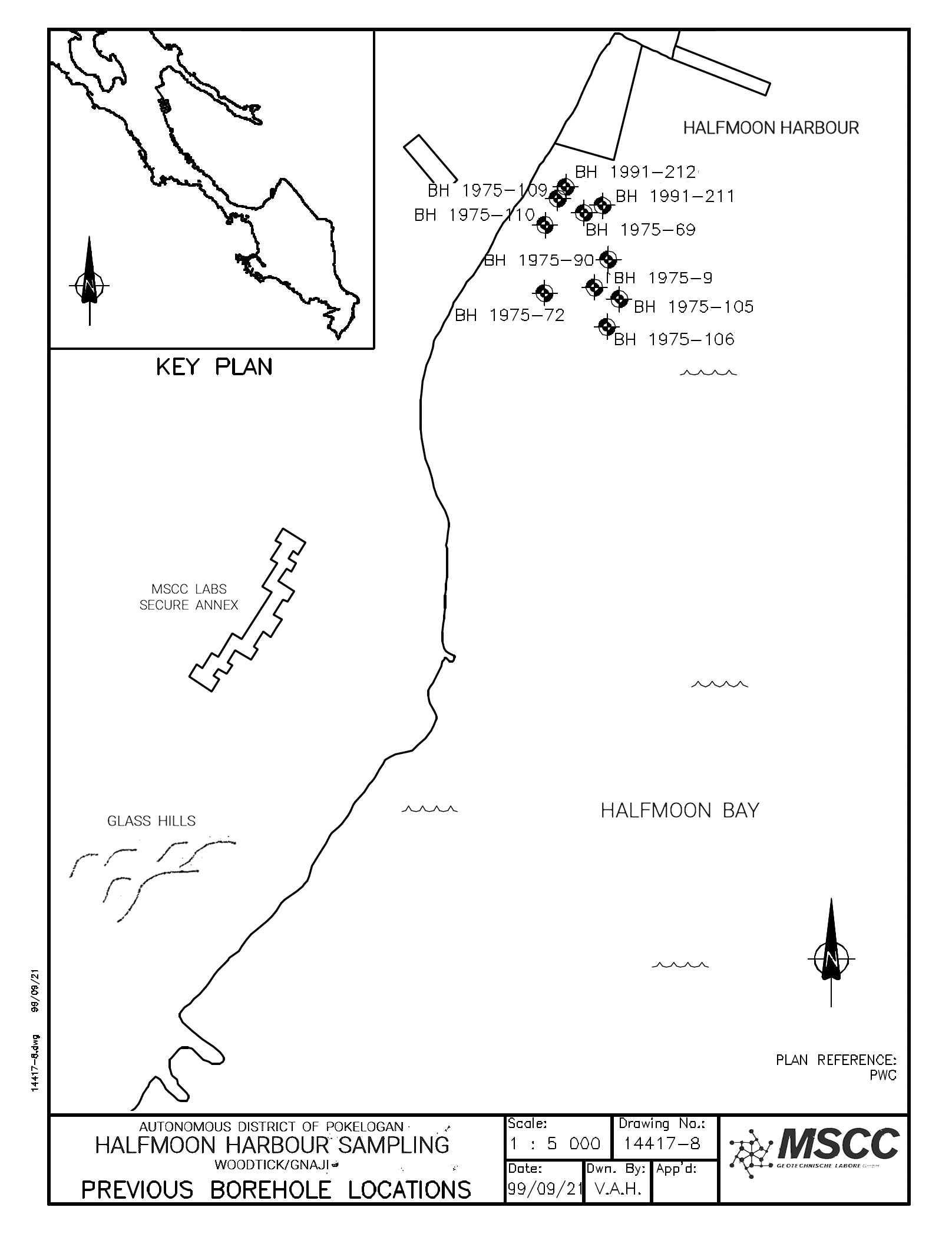
Diagram of existing bore holes drilled in Halfmoon Bay in 1999, near the MSCC Labs Annex.
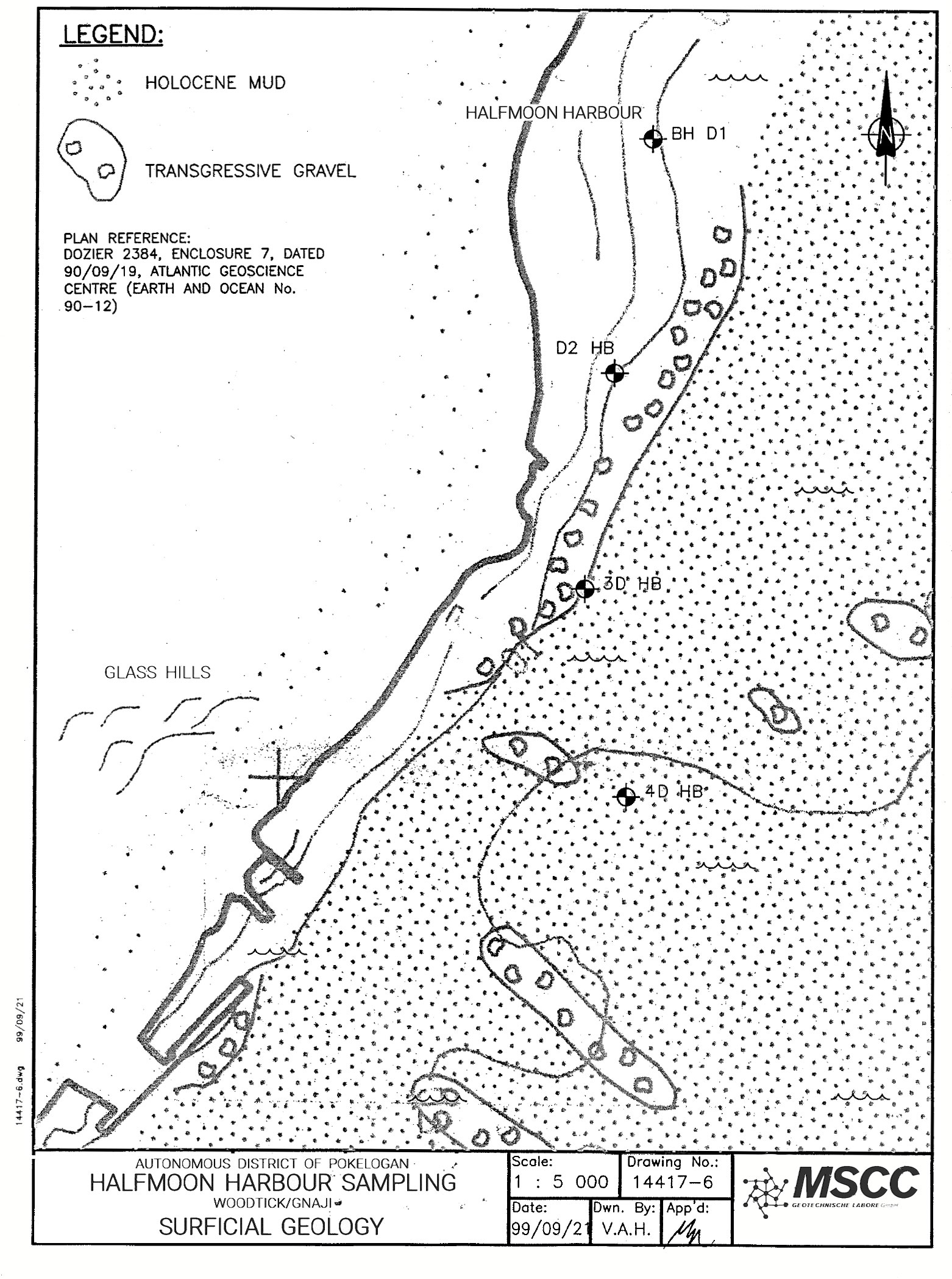
Surficial geology samples from Halfmoon Bay, 1999.
A good proportion Backwater’s hazards to life and limb were created on purpose by MSCC Labs, formerly the McNought & Schmid Mining Company. Overgrown mine shafts, abandoned tunnels and numerous bore holes pockmark the area around Halfmoon Bay and south to the Glass Hills. Few are adequately marked.
By about 1990, MSCC had already transitioned away from mineral extraction towards specialized geological and mineralogical testing. The above diagrams, dated 1999, show test bores drilled almost exclusively under the bay—unlikely to be related to prospecting.
Rumours about MSCC engaging foreign military contracts abound among locals. Two residents, Gail and Zoltan P., live on a property at an unusually high elevation for Backwater. They report watching thousands of truckloads of rock and dirt being removed during the construction of the Secure Annex, a sprawling complex on a bank above the bay. This suggests the excavation of an extensive underground space.
Shopkeepers Marie M. and Feather N-M. claim that the Annex contains living quarters for at least twenty people. They report serving customers with foreign accents and strange clothes who aren’t being housed anywhere in town, and whose purchases are always made with MSCC credits, no Rands or temporary visas required.
UNHOLY HOLE: THE CONDEMNED WING OF THE HERON HILL SCHOOL
According to some very odd District Council meeting transcripts, the community was shaken by an event in December 1992 that resulted in an entire wing of the Heron Hill public school being demolished and later buried under concrete.
An explosion in the basement that occurred on Christmas morning was first thought to be caused by a gas leak. Two boys were found to have been messing around in the building unsupervised in the days before, and had apparently managed to open what the school principal termed, controversially, “a hole in the fabric of reality.”
This hole was characterized by a greasy, putrid, extremely unpleasant atmosphere that “stirred up disturbing thoughts and overwhelming feelings of paranoia”—so much so that the wing was sealed off almost immediately.
It was later alleged that the two boys, one of whom was a member of the McNought family, had been attempting a black magic ritual in the basement over Christmas break and had done something egregious enough to destroy the basement and trigger a wave of depression and anxiety that swept through the townspeople.
How many were convinced this was true is not known. Council meeting transcripts detail bizarre injuries on the other boy, surnamed Oakum. which were extensive but inconsistent with having been through a gas explosion. But most of the discussion seems to have been about compelling the McNoughts to pay for a new school which, after several years of delay and consultation, they never actually did.
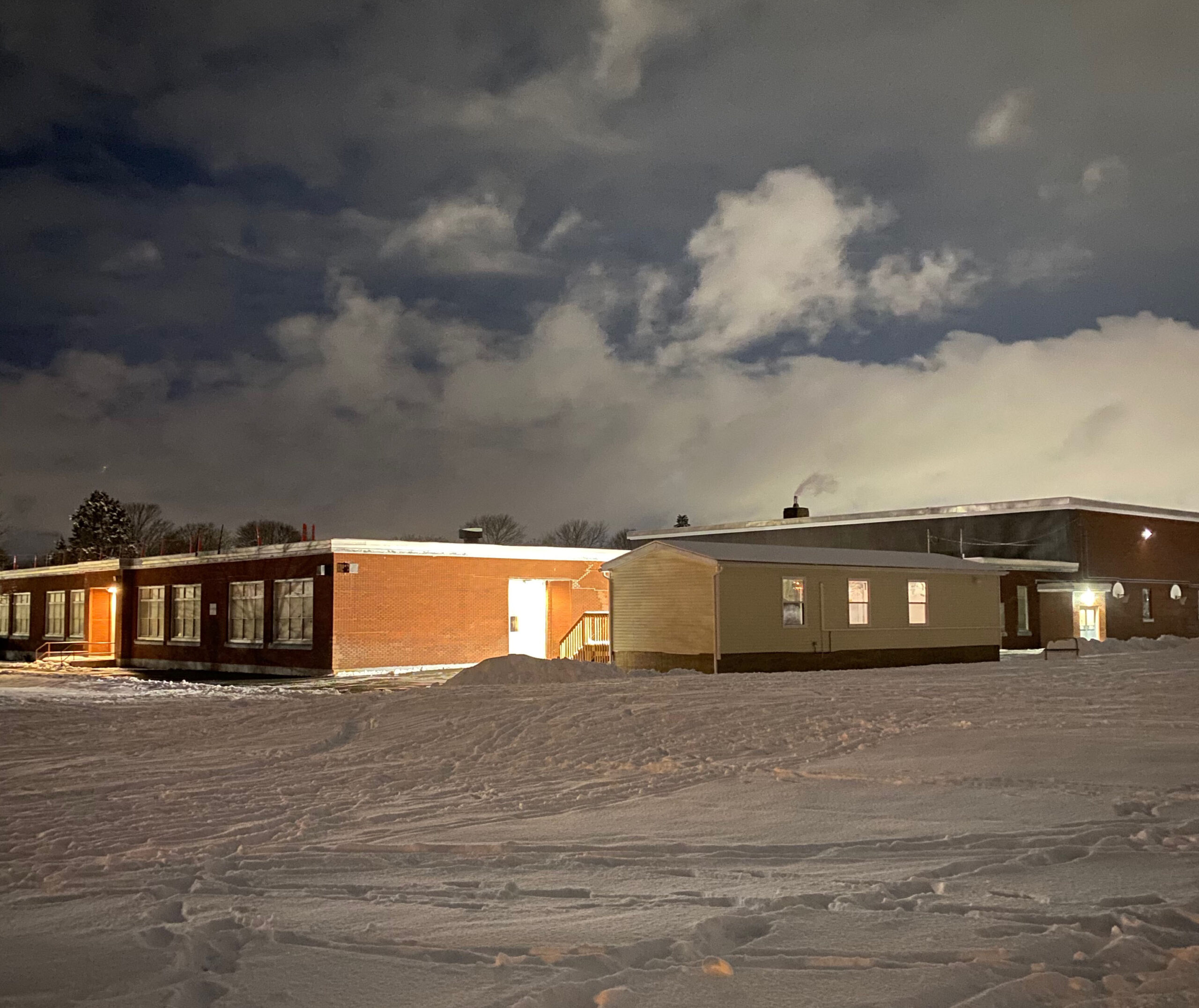
A portable sits where the east wing of Heron Hill school once stood. Under a concrete slab, the original basement, and its potentially realm-shattering secret, still exists.
DIGGERS COLLECTIVE OF POKELOGAN
WATERY ABYSS
TIA PEJU, ICTHYIC GODDESS
Vivian Wanderwood, Professor of Anthroposophy at Pokelogan University, authored an article published in The Theosophist’s Journal entitled “Deva Spirits of the Continental Shelf”:
[Picture of petroglyph] “The native peoples say that she is the spirit of this bay and that she has many other, smaller forms around her of a similar nature. Oral myths describe Tia Peju as a sort of water mushroom, a mycological trunk with many protruding heads, who acts in symbiosis with the bay pearls, also called siglak (perhaps derived from the Mi’kmaq word for roe). The now-forbidden practice of the “siglak sit”, a ten-day ceremony held on Tortoise Island, involving the consumption of—and sexual relations with—the bay pearls themselves, in order to merge with Tia Peju and divine important information about the coming seasons. In fact, the island once featured a ziggurat with a maze of tunnels below. An old spirit map of Pokelogan marks Tortoise Island with an icon that looks very much like a step pyramid.”
Dr. Leland Cox, a physician from Halifax who spent a documented three years as Pokelogan’s only doctor before disappearing in the summer of 1994, recalled his first encounter with an odd bronze statue that still stands in the town square:
[Leland’s sketch of town square statue of Tia Peju]
“The village hall turned out to be a large, handsome stone building adjacent to the village square, a small quadrangle facing the water. It featured a small rotunda and a tall bronze sculpture not of founder or forefather but of a highly stylized fish, rigid and upright, tail merging with the pedestal at the base, mouth open to the sky. A plaque at the base bore an inscription in Greek translating roughly to “Those who cannot catch fish should not blame the sea.”
UNSTABLE PORTALS OF BLACK LAKE
A Forest Friend collaboration. The material on this site is updated and maintained by volunteers. Datasets are released as resources become available.